Thermwood Announces Another New LSAM Model

Posted by Duane Marrett on Thu, Mar 05, 2020

Tags: Thermwood, Announcements, 3D printing, Additive, LSAM, LSAM 1010

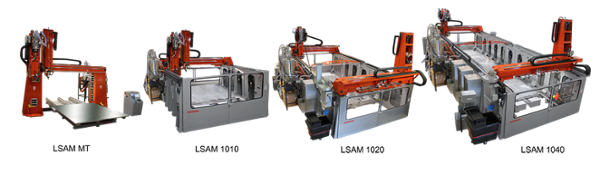
Thermwood recently announced the LSAM MT, a lower cost moving table version of its industry-leading LSAM (large scale additive system). Although Thermwood has hundreds of open moving table CNC routers in operation, similar in configuration to the MT, and believes this configuration will also work for many LSAM customers, several larger customers requested an enclosed machine configuration that is the same size as the MT, but configured like the larger LSAM high wall systems. 

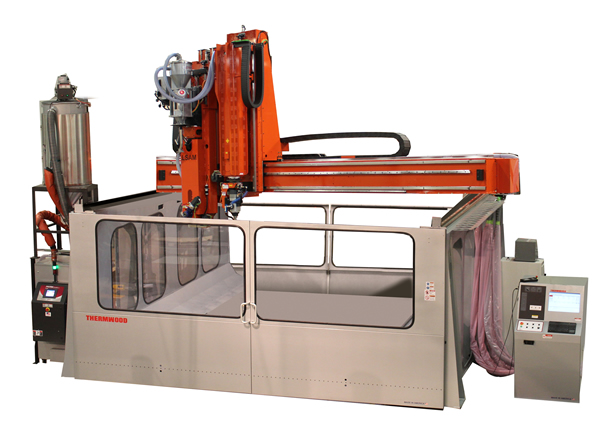
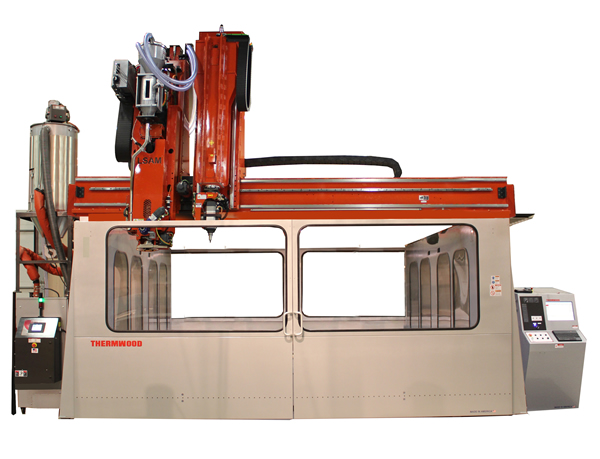
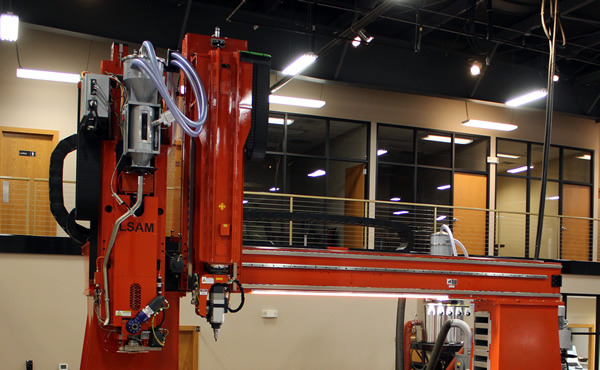
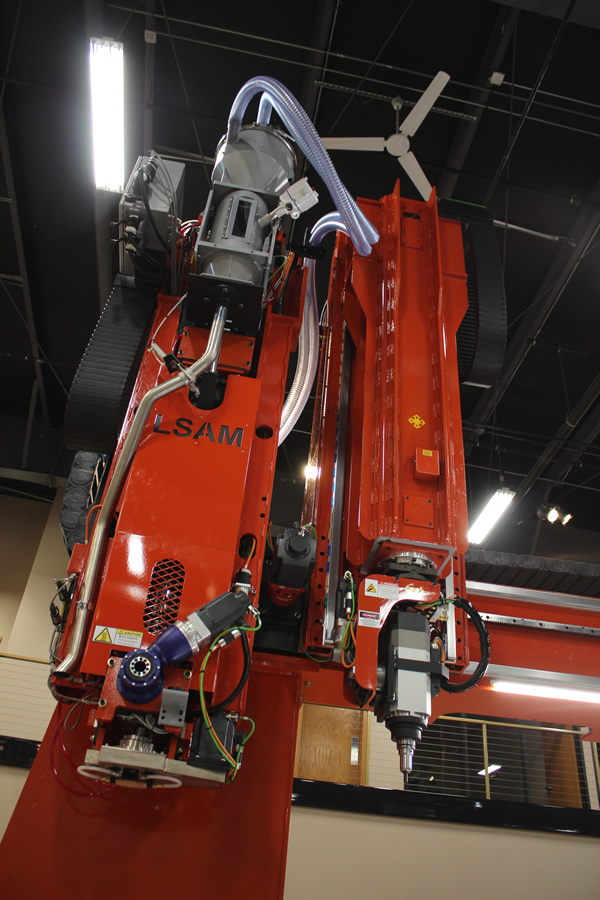
To address this request for a lower cost enclosed machine, Thermwood has announced the LSAM 1010. This system uses the walls from the larger LSAM systems with the gantry, control and sub-systems from the MT.


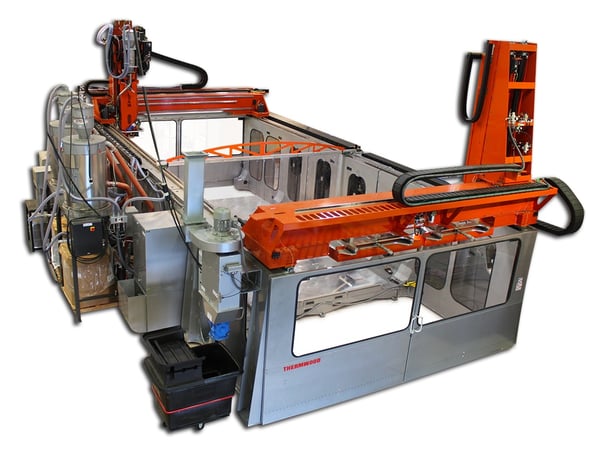
The new LSAM 1010 has both the print and trim heads on same the gantry just like the LSAM MT.

The new LSAM 1010 has both the print and trim heads on same the gantry just like the LSAM MT.


The Details

A single moving gantry on the LSAM 1010 carries both the print and trim heads just like on the MT.

The LSAM 1010 features a fixed 10 foot by 10 foot table. A single moving gantry carries both the print and trim heads as on the MT and, like the MT, it can both print and trim (but not at the same time). The print and trim heads on all Thermwood LSAMs are the same, so all machines can process virtually any reinforced composite thermoplastic materials available today.

The print and trim heads on all Thermwood LSAMs are the same, so all machines can process virtually any reinforced composite thermoplastic materials available today.

Although the LSAM 1010 is slightly higher in price than the MT, it is noticeably less than the larger LSAMs and generally less than the cost and complexity of trying to add an external enclosure to the MT.

In addition, even though the LSAM 1010 is slightly wider than the larger LSAMs (to accommodate mounting both the print and trim heads on the same gantry), the overall footprint of the 1010 is actually slightly smaller than required for the MT. And, like the MT, the 1010 can be purchased as a print only machine. 

Thermwood believes that, since it is enclosed like the larger LSAMs, the LSAM 1010 can be built to meet European CE requirements, just like the larger machines.

With the introduction of the LSAM 1010, it is clear that Thermwood is committed to responding to customer requests and providing its industry-leading LSAM additive manufacturing technology in a variety of configurations to better fit varying customer requirements.

About Thermwood Corporation

Thermwood is a US based, multinational, diversified CNC machinery manufacturer that markets its products and services through offices in 11 countries. Thermwood is the oldest manufacturer of highly flexible 3 & 5 axis high-speed machining centers known as CNC routers.

Thermwood has also become the technology and market leader in large scale additive manufacturing systems for thermoplastic composite molds, tooling, patterns and parts with its line of LSAM (Large Scale Additive Manufacturing) machines that both 3D print and trim on the same machine. These are some of the largest and most capable additive manufacturing systems ever produced and are marketed to major companies in the aerospace, marine, automotive and foundry industries as well as military, government and defense contractors.


Click for More Info on the Thermwood LSAM

CGTech and Thermwood Team up to Simulate Additive & Hybrid Machining

Posted by Duane Marrett on Thu, Feb 27, 2020

Tags: Thermwood, Announcements, 3D printing, Additive, LSAM, LSAM MT, CGTech, Vericut, Simulation

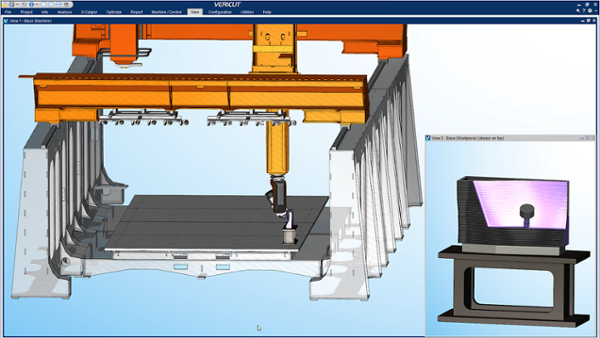
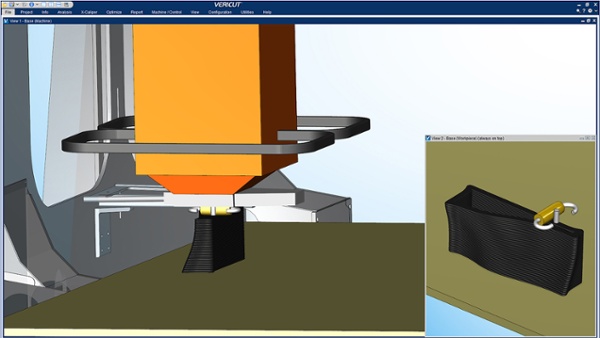
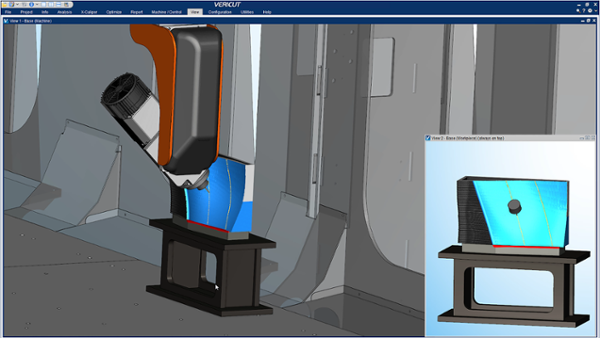
CGTech, makers of industry leading VERICUT software, has partnered with Thermwood to simulate both the additive 3-D Printing and subtractive machining capabilities of their LSAM machines.

LSAM is designed for large scale 3-D printing of thermoplastic polymers. Thermwood’s LSAM machines utilize unique patented technology to produce the highest quality thermoplastic polymer printed structures available. The machines feature both additive and subtractive heads to accommodate printing and trimming of large scale “near net shape” parts on the same machine. Thermwood’s LSAM machines are available in Dual Gantry and Moving Table models, in a variety of sizes. Both systems can process high temperature polymers which are ideal for autoclave capable tooling or compression molds for thermoset materials.

"We have over 55 patented features (and over a dozen more pending) that set the LSAM apart from any other large scale additive system available today.  Features like our chilled roller wheel, vertical layer printing system and LSAM Print 3D software make us the clear leader in large scale additive manufacturing,” says Dennis Palmer, Vice President of Sales at Thermwood. "VERICUT is an important tool to use with LSAM.  It assures that the tool path is correct, eliminating the possibility of expensive mishaps."

Vericut LSAM simulation

VERICUT's Additive module simulates both additive 3-D printing and traditional machining capabilities of hybrid CNC machines to verify that the full manufacturing process will work,and the finished part matches the intended engineered design. VERICUT simulates adding or cutting, in any sequence, making it the perfect solution for verification, simulation and optimization of Thermwood's industrial LSAM machines.

Vericut LSAM simulation

CGTech’s VERICUT Product Manger, Gene Granata, says “CGTech is thrilled to be working closely with the Thermwood team to provide the highest degree of simulation possible for their large scale additive machines. VERICUT’s Additive and hybrid simulation software is a perfect match for the LSAM’s highly versatile and capable environment."

Vericut LSAM simulation

To learn more about the partnership and see an LSAM simulation in action, click here.

About CGTech

About CGTechCGTech’s VERICUT® software is the standard for CNC simulation, verification, optimization, analysis, and additive manufacturing. CGTech also offers programming and simulation software for composites automated fiber-placement, tape-laying, and drilling/fastening CNC machines. VERICUT software is used by companies of different sizes in all industries. Established in 1988, and headquartered in Irvine, California; CGTech has offices worldwide. For more information: visit the CGTech website at cgtech.com, call (949) 753-1050, or email info@cgtech.com.

About Thermwood Corporation

Thermwood is a US based, multinational, diversified CNC machinery manufacturer that markets its products and services through offices in 11 countries. Thermwood is the oldest manufacturer of highly flexible 3 & 5 axis high-speed machining centers known as CNC routers.

Thermwood has also become the technology and market leader in large scale additive manufacturing systems for thermoplastic composite molds, tooling, patterns and parts with its line of LSAM (Large Scale Additive Manufacturing) machines that both 3D print and trim on the same machine. These are some of the largest and most capable additive manufacturing systems ever produced and are marketed to major companies in the aerospace, marine, automotive and foundry industries as well as military, government and defense contractors.

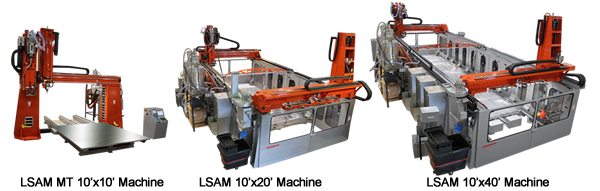
Thermwood offers a full line of LSAM sizes to fit almost any application
LSAM line of Additive Manufacturing Machines


Click for More Info on the Thermwood LSAM

Thermwood Promotes Jennifer Watt to Chief Legal Officer

Posted by Duane Marrett on Fri, Dec 20, 2019

Tags: Thermwood, Announcements, Employees, Promotions

jennifer_watt_headshot_800_wideThermwood Corporation is pleased to announce the appointment and promotion of Jennifer Watt as its Chief Legal Officer, Secretary and Vice President. In this role, Ms. Watt has oversight of all legal aspects of the company and its corporate governance.  Jennifer previously served as Vice President and General Counsel for the company.  Prior to joining Thermwood, Jennifer was an Associate with the Indianapolis based law firm of Kroger, Gardis & Regas and the Chicago based law firm of Leo & Weber. 

Jennifer earned her J.D. degree from the Chicago-Kent College of Law and a Bachelor of Science in Business from the Indiana University Kelley School of Business.  She is a licensed member of the Indiana and Illinois Bar Associations. 

About Thermwood Corporation

Thermwood is a US based, multinational, diversified CNC machinery manufacturer that markets its products and services through offices in 11 countries. Thermwood is the oldest manufacturer of highly flexible 3 & 5 axis high-speed machining centers known as CNC routers.

Thermwood has also become the technology and market leader in large scale additive manufacturing systems for thermoplastic composite molds, tooling, patterns and parts with its line of LSAM (Large Scale Additive Manufacturing) machines that both 3D print and trim on the same machine. These are some of the largest and most capable additive manufacturing systems ever produced and are marketed to major companies in the aerospace, marine, automotive and foundry industries as well as military, government and defense contractors.

Thermwood Structural Changes and Promotions

Posted by Duane Marrett on Thu, Dec 12, 2019

Tags: Thermwood, Announcements, Employees, Promotions

Thermwood, who has been producing CNC routers longer than anyone else, is now celebrating its 50th anniversary. It is also experiencing unprecedented growth. 

Much of this growth is attributed to the success of its new large scale additive manufacturing systems. Called LSAM (L-Sam), these are industrial sized 3D printers, some capable of printing composite parts up to forty feet long and weighing several tons. These machines are currently producing large composite structures from the chassis of an autonomous urban bus to tooling for the production of the interior of modern jet aircraft. 

These systems are transforming the company, resulting in structural management changes and new advancement opportunities.  

Thermwood Appoints Jason Susnjara as Executive Vice President

Thermwood Appoints Jason Susnjara as Executive Vice President

We are pleased to announce the promotion of Jason Susnjara to Executive Vice President. Jason has been with Thermwood since 1995 and has held numerous positions, most recently as Vice President of Marketing.  He is also on Thermwood’s board of directors.

In this new position he will oversee and manage Thermwood’s technology, engineering, manufacturing and marketing operations. Thermwood operates a complex manufacturing operation, building some of the most technically sophisticated industrial products built today. In his new position Jason will manage the operation and expansion of these activities to support ongoing growth.

Jason resides in southern Indiana with his wife April and their three children. 

Thermwood Appoints Brian Smiddy as Vice President of Product Development

Thermwood Appoints Brian Smiddy as Vice President of Product DevelopmentWe are pleased to announce the promotion of Brian Smiddy to Vice President of Product Development.  He has been with Thermwood since 1995 and has managed the engineering department over the past 17 years.

In this new position, Brian will be responsible for new technology development and incorporation of that technology into Thermwood’s product line and production processes. In the past three years Brian has assisted in activities that have generated over 50 patents on new technical developments. In his new position, he will be able to focus more directly on these vital activities.

Brian resides in southern Indiana with his wife Michanne and daughter. 

Thermwood Appoints Larry Epplin as Vice President of Software Development

Thermwood Appoints Larry Epplin as Vice President of Software DevelopmentWe are pleased to announce the promotion of Larry Epplin to Vice President of Software Development.  He has been with Thermwood since 2000 developing and managing the Company’s cabinet design software products. 

In this new position, Larry will manage the development of Thermwood’s software product line, including integrating a type of artificial intelligence into Thermwood’s CNC control so that cabinet makers can produce and almost unlimited number of products without needing a CNC programmer. He will also oversee continued development of Thermwood’s industry leading industrial 3D printing software and manage a network of thousands of cabinet shops currently using Thermwood software to design their products and run their shops.

Larry resides in southern Indiana with his wife Kristi.

Thermwood Promotes Duane Marrett to Vice President of Marketing

Thermwood Promotes Duane Marrett to Vice President of MarketingWe are pleased to announce the promotion of Duane Marrett to Vice President of Marketing.  Duane’s career at Thermwood began in 1998 in the engineering department as a technical writer. He has held positions with ever increasing responsibility in various marketing functions. In his most recent position, he developed and managed the company web site, interacted with traditional and social media along with creating promotional videos, issuing product releases and conducting market analytics for the company. 

In Duane’s new position, he will manage Thermwood’s overall marketing function including development and execution of trade show exhibitions around the world and overall management of company functions.

Duane resides in southern Indiana with his wife Carrie and son.

Thermwood Promotes John Fuquay to Manager of Engineering

Thermwood Promotes John Fuquay to Manager of EngineeringWe are also pleased to announce the promotion of John Fuquay to the Manager of Engineering.  He has been with Thermwood since 2003 in engineering, designing products and providing documentation for production.

In his new position John will manage the engineering department, implementing new product designs, maintaining the extensive engineering database and providing engineering support to manufacturing.


John resides in southern Indiana with his wife Rachael and their two sons.

About Thermwood Corporation

Thermwood is a US based, multinational, diversified CNC machinery manufacturer that markets its products and services through offices in 11 countries. Thermwood is the oldest manufacturer of highly flexible 3 & 5 axis high-speed machining centers known as CNC routers.

Thermwood has also become the technology and market leader in large scale additive manufacturing systems for thermoplastic composite molds, tooling, patterns and parts with its line of LSAM (Large Scale Additive Manufacturing) machines that both 3D print and trim on the same machine. These are some of the largest and most capable additive manufacturing systems ever produced and are marketed to major companies in the aerospace, marine, automotive and foundry industries as well as military, government and defense contractors.

Thermwood Introduces New LSAM Model

Posted by Duane Marrett on Mon, Nov 18, 2019

Tags: Thermwood, Announcements, 3D printing, Additive, LSAM, LSAM MT

At its 50th Anniversary Gala Open House, Thermwood introduced and demonstrated an all new LSAM additive manufacturing machine model, offering even more choices for large scale additive manufacturing applications. Called LSAM MT, the new machine offers an all new configuration and significant advantages in certain applications.
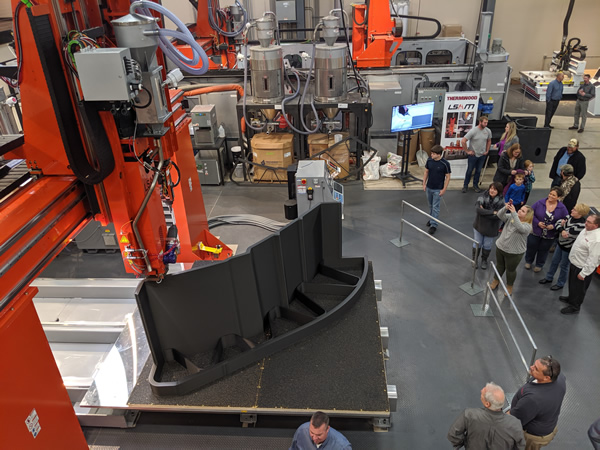
Crowds watch the LSAM MT demonstration at the Thermwood 50th Anniversary Gala Open House

Crowds watch the LSAM MT demonstration at the Thermwood 50th Anniversary Gala Open House

Video

Please click below to see a video of the LSAM MT in action!


The Details

Unlike standard LSAM systems, which feature dual gantries operating over a large fixed table, the MT (which stands for “Moving Table”) features a single fixed gantry mounted over a moving table. Available with a 10x10 foot table, this configuration offers several significant advantages, not the least of which is a dramatically lower price.

Despite the lower price, the LSAM MT is still a massive, robust industrial production machine capable of reliable, day in and day out production. Unlike standard LSAM systems, the MT can be configured as a “Print Only” machine. The logic for this is simple.
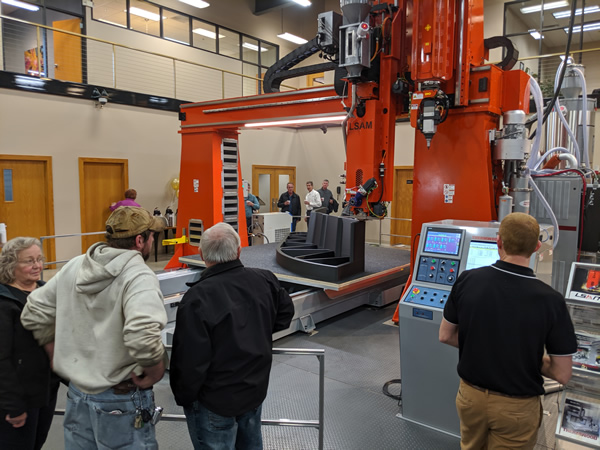
Despite the lower price, the LSAM MT is still a massive, robust industrial production machine

Despite the lower price, the LSAM MT is still a massive, robust industrial production machine

New Options

Near net shape printed tools dramatically reduce machining time for many companies currently machining tools from solid blocks of material. This frees up significant machining capacity which is already purchased and installed. For these companies, it makes no sense to purchase additional machining capacity with their additive system, since the change to additive frees up more than enough existing capacity to handle everything they can print. With this in mind, Thermwood decided to offer both “Print and Trim” and a “Print Only” versions of the MT.

The MT is available with a 10 foot by 10 foot table. The 10 x 10 machine actually has a 10 x 12 foot table with a 10 x 10 working area. The extra 2 foot is used to mount an optional Vertical Layer Print table. The 10 x 10 foot MT can be equipped with a new version of Thermwood’s patented Vertical Layer Printing technology. This means that it can make parts up to 10'x10' by 5 foot high using traditional Horizontal Layer Printing or, 5'x10' by 10 foot high using Vertical Layer Printing.

Since the print technology and print heads used on the MT are the same as used on the larger machines it offers the same throughput, print quality and layer to layer fusion that has made LSAM the leader in large scale additive manufacturing. As with the larger systems, the MT can process high temperature polymers which are ideal for autoclave capable tooling or compression molds for thermoset materials.
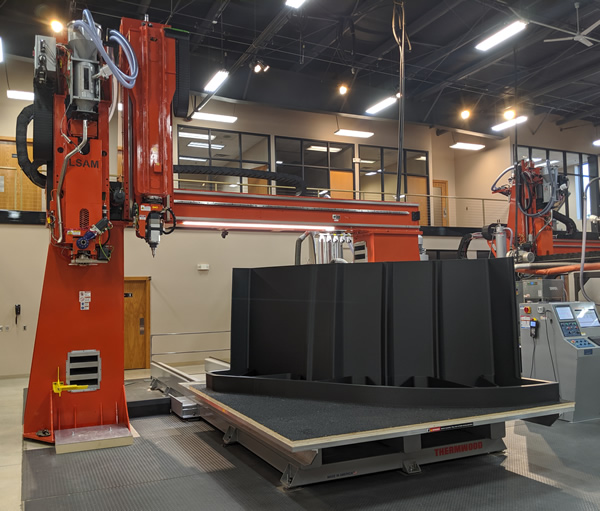
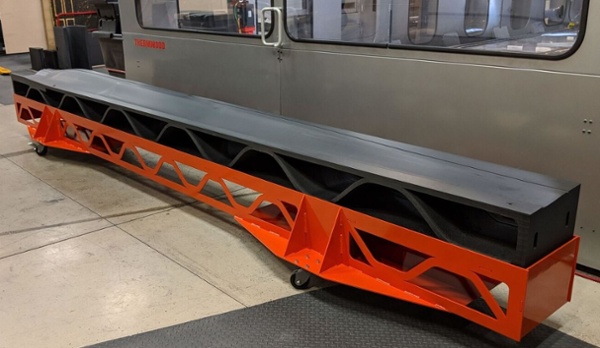
The large demonstration part printed at the open house is one of twenty similar parts which when combined become a production mold for a large yacht hull
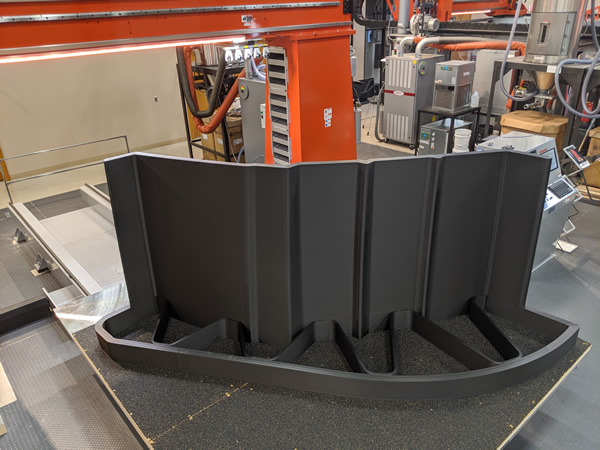
The large demonstration part printed at the open house is one of twenty similar parts which when combined become a production mold for a large yacht hull

With the same print technology as used on the larger LSAM machines, the MT offers the same throughput, print quality and layer to layer fusion that has made LSAM the leader in large scale additive manufacturing
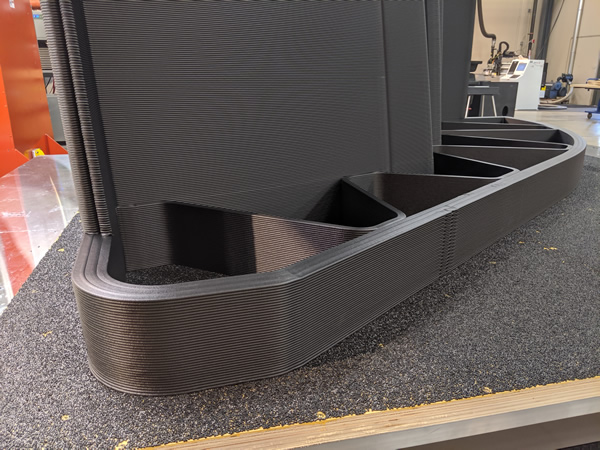

The LSAM MT is the ideal additive machine for a variety of exciting new applications

The LSAM MT is the ideal additive machine for a variety of exciting new applications

Things to Consider

With the addition of the MT, selecting the best size and configuration for an LSAM may not be quite as straightforward as it first appears. It depends on two major factors plus some additional considerations. The major factors are the material being printed and the size of the parts needed. Of these two, the material being printed is the most significant.
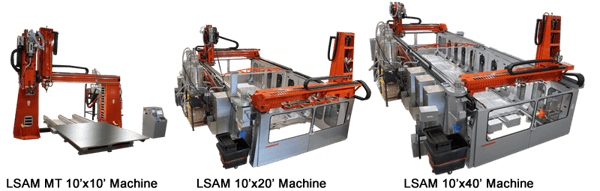
Thermwood offers a full line of LSAM sizes to fit almost any application

Thermwood offers a full line of LSAM sizes to fit almost any application

For purposes of machine selection, reinforced thermoplastic composite materials for room temperature or low temperature applications such as foundry patterns, boat plugs, boat and yacht molds, building structures and the like can generally be bonded securely with a variety of industrial adhesives. For these type of parts, even for really large parts, the smaller less expensive machine may be a better choice. The part can be separated into sections which can be printed individually and bonded into the final, potentially extremely large structure.

Although it seems counter-intuitive, this approach can be faster than printing the large structure as a single piece on a larger, more expensive machine. To better understand this we turn to the basics of the print process. Additive manufactured parts are printed in layers. The speed at which a layer can be printed depends primarily on how long it takes for the polymer being printed to cool enough to support the next layer. This layer cooling time depends on the polymer and is not affected by the size of the part. Each layer of a particular polymer takes the same amount of time, regardless of how big it is.

LSAM print heads can print faster, sometimes significantly faster than needed for most parts. Often it can print two three or more parts in the cooling time required for each layer. The large machine is only printing a single part, one layer at a time, making it two or three time slower. To print the part in one piece, the large machine must operate continuously, around the clock, sometimes for days.  This is not a problem for factories that operate on all three shifts but can present staffing problems for single shift operations. With the MT, several different segments of the same part can often be printed in a single shift. Depending on the item being printed, it is possible to print as much in a single shift as the large machine, printing a single part, can do in 24 hours.

For large parts made from bondable materials, often the smaller, less expensive machine is a better choice.

Materials intended for high temperature applications, PSU, PESU, PEI, Ultem, etc. generally are resistant enough to solvents that they can’t be effectively bonded. Even if they could, few if any, adhesives exist that can withstand the operating temperature or the thermal cycling these materials experience. For these applications, the machine needs to be large enough to print the part in one piece, even though it could be slower. This is where larger machine configurations are needed. The larger machines also offer the ability to print and trim at the same time, which may be beneficial in some circumstances.

Since the print heads are the same on all Thermwood LSAMs, the smaller MT can be used for these high temperature parts, provided they fit in the available envelope.

Just like the standard LSAMs, the MT comes complete, fully engineered with everything needed for production operation. 

About Thermwood Corporation

Thermwood is a US based, multinational, diversified CNC machinery manufacturer that markets its products and services through offices in 11 countries. Thermwood is the oldest manufacturer of highly flexible 3 & 5 axis high-speed machining centers known as CNC routers.

Thermwood has also become the technology and market leader in large scale additive manufacturing systems for thermoplastic composite molds, tooling, patterns and parts with its line of LSAM (Large Scale Additive Manufacturing) machines that both 3D print and trim on the same machine. These are some of the largest and most capable additive manufacturing systems ever produced and are marketed to major companies in the aerospace, marine, automotive and foundry industries as well as military, government and defense contractors.
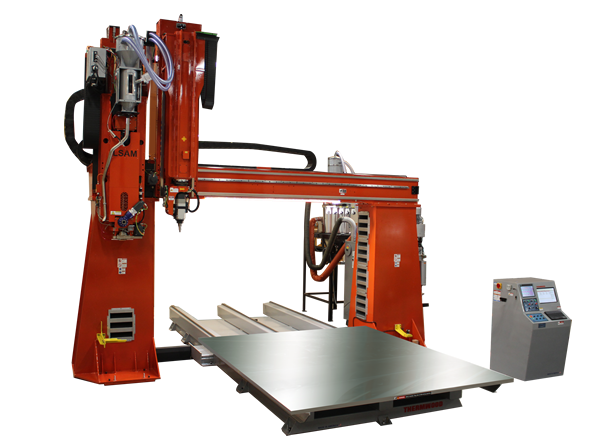
10’ x 10’ LSAM MT (Large Scale Additive Manufacturing)


Click for More Info on the Thermwood LSAM

Thermwood and Purdue Successfully Compression Mold Parts Using Printed Tooling

Posted by Duane Marrett on Mon, Nov 11, 2019

Tags: Thermwood, Announcements, Purdue, 3D printing, Additive, LSAM, Compression


Thermwood and Purdue’s Composite Manufacturing & Simulation Center have been working together to develop and test methods of using 3D printed composite molds for the compression molding of thermoset parts. They have just announced that they have successfully been able to compression mold test parts using 3D printed composite tooling.

Thermwood and Purdue’s Composite Manufacturing & Simulation Center have been working together to develop and test methods of using 3D printed composite molds for the compression molding of thermoset parts. They have just announced that they have successfully been able to compression mold test parts using 3D printed composite tooling.

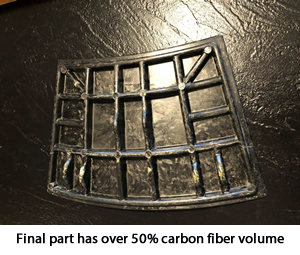
Final part has over 50% carbon fiber volume

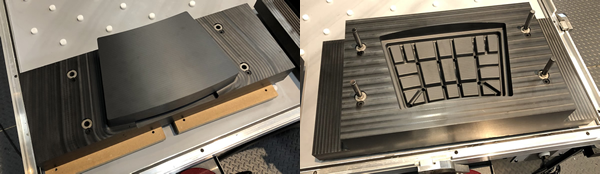
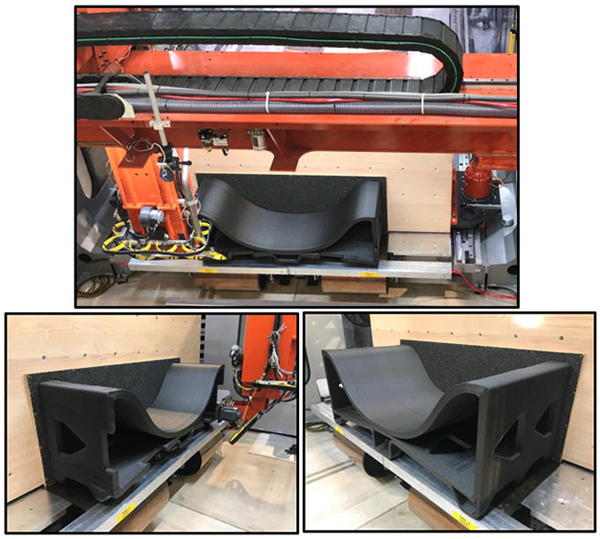
The test part, a half scale thrust reverser blocker door for a jet engine, was designed at Purdue and is approximately 10x13x2 inch in size. The two-part matched compression mold for the part was 3D printed using Techmer PM 25% carbon fiber reinforced PESU at Thermwood, using its LSAM large scale additive manufacturing system.

The mold halves were then machined to final size and shape on the same system. The completed tool was next taken to Purdue’s Composite Manufacturing & Simulation Center, in West Lafayette Indiana, where it was mounted to their 250 ton compression press. Parts were then molded from Dow’s new Vorafuse prepreg platelet material system with over 50% carbon fiber volume fraction.

The Details

Both halves of the mold were printed at the same time during a single 2 hour and 34 minute print cycle. When using Thermwood’s “continuous cooling” print process, the polymer cooling determines the cycle time for each layer, allowing both halves to be printed in the same time it would take to print one half (since both parts could be printed in the layer cooling time available).

Both halves of the mold were printed in less then 3 hours

Both halves of the mold were printed in less than 3 hours

Machining, however, must be done in the traditional manner, one part at a time, although there is an advantage to machining printed parts. Since the part is printed to near net shape, the overall amount of material that must be removed is significantly less than if the tool was machined from a solid block. Machining of the two mold halves required an additional 27 hours.

The first attempt at compression molding was not successful, but techniques were developed to account for the mechanical and thermal conductivity characteristics of the polymer print material and a second attempt produced acceptable parts.

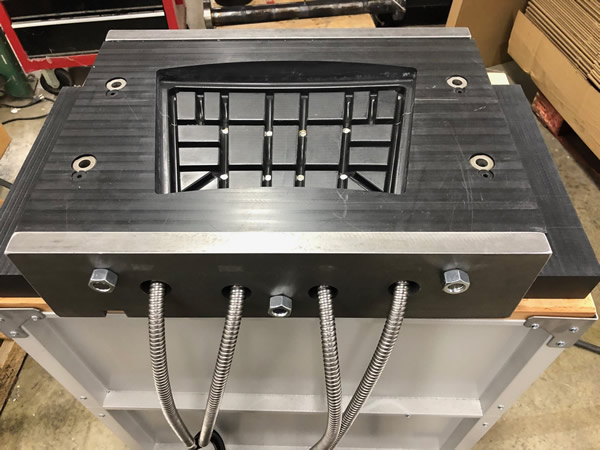
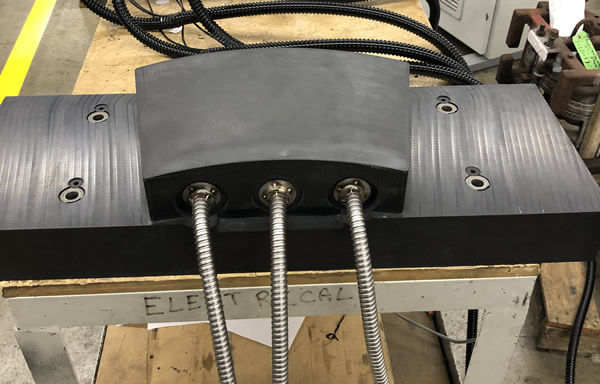
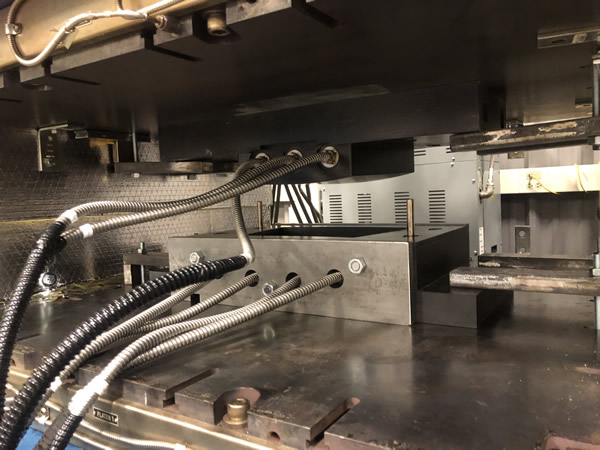
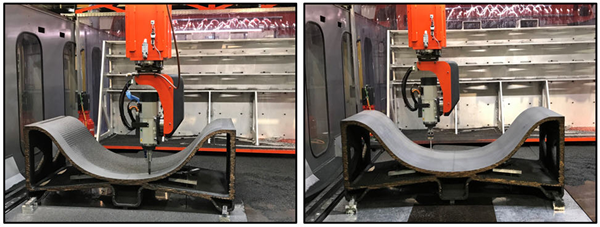
The team determined that using printed composite molds in a compression press does require a significantly different approach than a tool for the same part machined from a block of metal. First, the tool must be internally heated since the polymer composite doesn’t transmit heat as well as metal. Thermwood developed a technique for deep hole boring of the printed composite part using the trim head on its LSAM machine, allowing the deep insertion of cartridge heaters.

A special heat control allows the temperature of various areas of the tool to be controlled independently, helping address the challenge of balancing the thermal characteristics of the thermoplastic composite mold with the processing temperature requirements of the thermoset material being processed.

Printed polymer composite mold must be heated and reinforced

Printed polymer composite mold must be heated and reinforced

Printed polymer composite mold must be heated and reinforced

Printed polymer composite mold must be heated and reinforced

Also, the outside of the mold must be reinforced so that the composite polymer used for the mold itself is under only compression loads and not tension during the molding operation, since forces developed during molding are greater than the tensile strength of the composite polymers used for the mold. This approach has successfully withstood molding pressure of 1,500 PSI during initial testing and the team believes even higher pressures are possible.

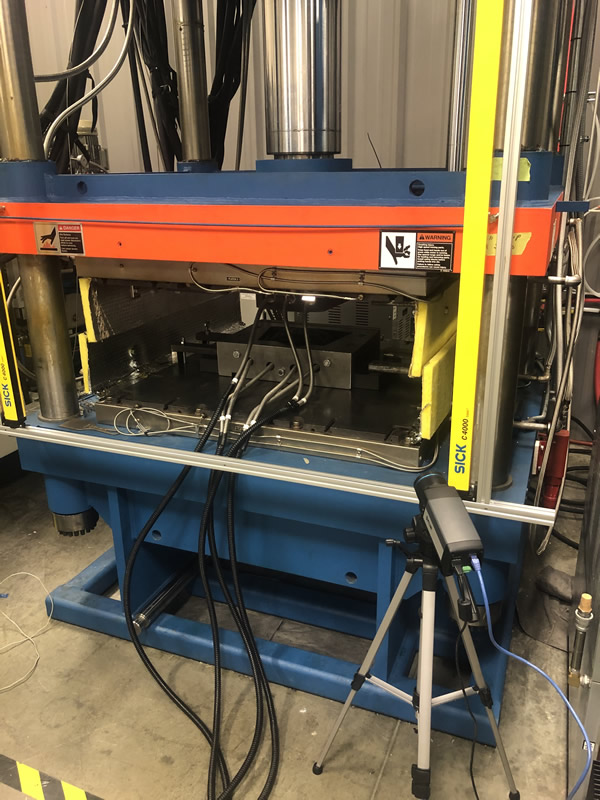
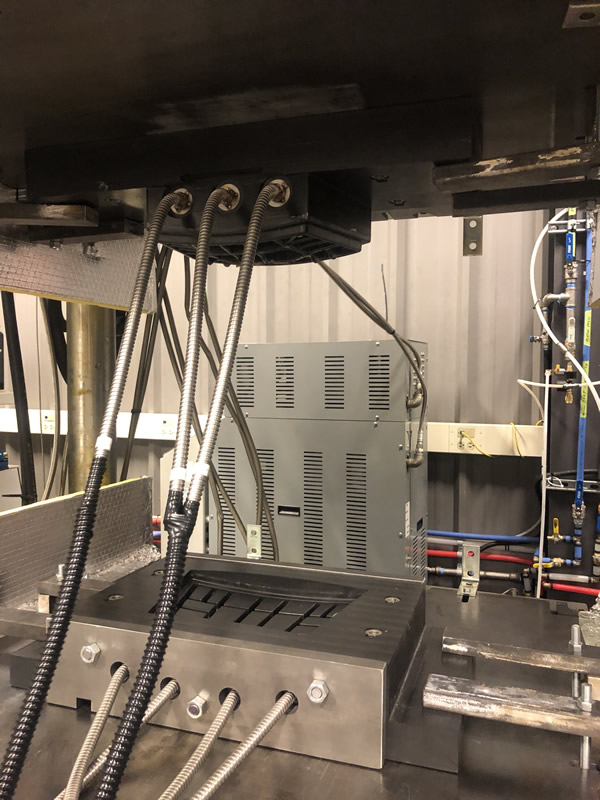
Parts were made on Purdue’s 250 ton compression press

Parts were made on Purdue’s 250 ton compression press

Parts were made on Purdue’s 250 ton compression press

Parts were made on Purdue’s 250 ton compression press

Parts were made on Purdue’s 250 ton compression press

Parts were made on Purdue’s 250 ton compression press

Final Thoughts

Both Thermwood and Purdue believe this is an important first step in bringing additive manufacturing to compression molding. The speed and relatively low cost of printed compression tools has the potential to significantly modify current industry practices. Printed tools are ideal for prototyping and can potentially avoid problems with long lead time, expensive production tools by validating the design before a final version is built.

Additional development effort will be needed to further refine tool design and broaden the range of parts that this process will support, but all parties involved believe that this project demonstrates the viability of the basic approach.

Potential applications in the auto industry include prototyping and production tool verification. Because of high volume requirements for auto production, it is unlikely that these tools would function adequately for full production use, but actual useful production life is still unknown. It will require additional testing to determine just how many parts can be molded from an additive manufactured compression mold and what the ultimate failure mode actually is.

In aerospace, parts tend to be much larger and production volumes much lower, so it is possible that printed compression molds could find actual production use for larger, lower volume aerospace components, perhaps replacing open face tools and autoclaves for certain parts.

The relatively low cost and fast build rate of these additive molds significantly alters the decision matrix and timeline for developing new products using compression molding.

Purdue’s Composites Manufacturing & Simulation Center

The Composites Manufacturing & Simulation Center (CMSC) is a bridge between the academic and industrial communities, connecting the global composites industry and Indiana manufacturing to Purdue University.  The CMSC research is driven by industry needs and grounded in academic rigor.  Global sponsors and partners include aerospace and automotive OEMs, Tier 1 and 2 suppliers, materials suppliers, wind turbine manufacturers, and commercial software providers.  The CMSC is a collaboration of the College of Engineering and the Purdue Polytechnic Institute and is a Purdue University Center of Excellence.

State-of-the-art manufacturing and characterization facilities provide a one-stop-shop for composites design, manufacturing, prototyping and model validation.  Finally, the CMSC is dedicated to training engineers across the entire composites community in composites manufacturing and simulation.

Thermwood Corporation

Thermwood is a US based, multinational, diversified CNC machinery manufacturer that markets its products and services through offices in 11 countries. Thermwood is the oldest manufacturer of highly flexible 3 & 5 axis high-speed machining centers known as CNC routers.

Thermwood has also become the technology and market leader in large scale additive manufacturing systems for thermoplastic composite molds, tooling, patterns and parts with its line of LSAM (Large Scale Additive Manufacturing) machines that both 3D print and trim on the same machine. These are some of the largest and most capable additive manufacturing systems ever produced and are marketed to major companies in the aerospace, marine, automotive and foundry industries as well as military, government and defense contractors.

Thermwood 10'x20' LSAM

10’ x 20’ LSAM (Large Scale Additive Manufacturing)


Click for More Info on the Thermwood LSAM

Latest Cut Ready Update Adds Combination Cabinets and Much More

Posted by Duane Marrett on Mon, Aug 12, 2019

Tags: Thermwood, software update, Announcements, Cut Ready, Cut Center, cabinets, Cut Center Updates, Combination Cabinets, Dovetail Drawerbox

At the recent AWFS show, Thermwood announced exciting new features for its Cut Ready systems. Called “Combination Cabinets” this creates a single structure comprised of multiple cabinets, and like all Cut Ready products it all happens with no CNC programming, making the Cut Ready Cut Center even more valuable.

But, what about all the folks who already have Cut Centers who don’t have this feature? The good news is that with the next free system update, they also get all the new features (even though they didn’t exist when the machine was bought new).

Cut Centers don’t go obsolete, they become more valuable over time.

This latest update features the addition of Combination Cabinets, dovetail drawer box updates and the ability to generate a dimensional listing of all face frame parts.  No matter if your Cut Ready/Cut Center is brand new or was the first one delivered, this will update your machine to the latest features available for you to use, and it’s free.

New Combination Cabinets Feature Added

One of the most important time and material cost saving features ever released – Combination Cabinets – allows you to easily create large kitchen cabinets with multiple sections.  This feature reduces your machine time by 25 to 35 percent and your part count by 50 percent or higher, all without the need for a programmer or expensive design software.

By customizing the size and style of each opening, you can now create endless combinations for both frameless & face frame kitchen cabinets.  Choose from many different options for these sections from one or two doors, with/without drawers, false fronts, open sections, slotted areas for storage along with numerous other variations.

Combination Cabinets created in Cut Ready

Combination Cabinets created in Cut Ready

Check Out The Video!

Drawer Box Joint Improvements

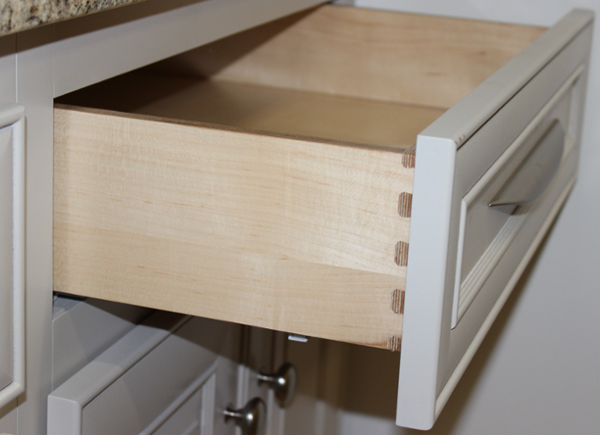
Cut Ready’s dovetail drawer box application has been refined to provide our users with the highest precision fit and accuracy possible for dovetail construction. 

Latest Cut Ready Update Improves Dovetail Drawer Box Fit and Accuracy

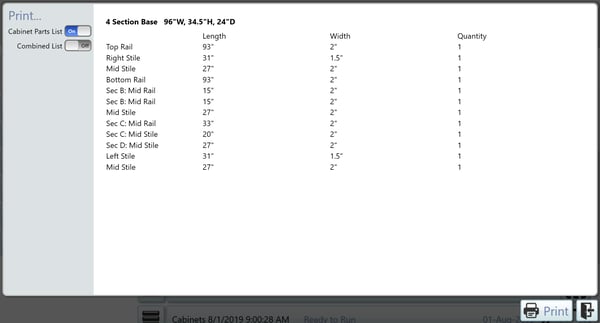
Generate a Face Frame Part Dimensional Listing

Cut Ready now has the ability to generate a dimensional listing of all face frame parts. This provides both length and width of all parts in an easy to read listing.

Cut Ready now has the ability to generate a dimensional listing of all face frame parts.

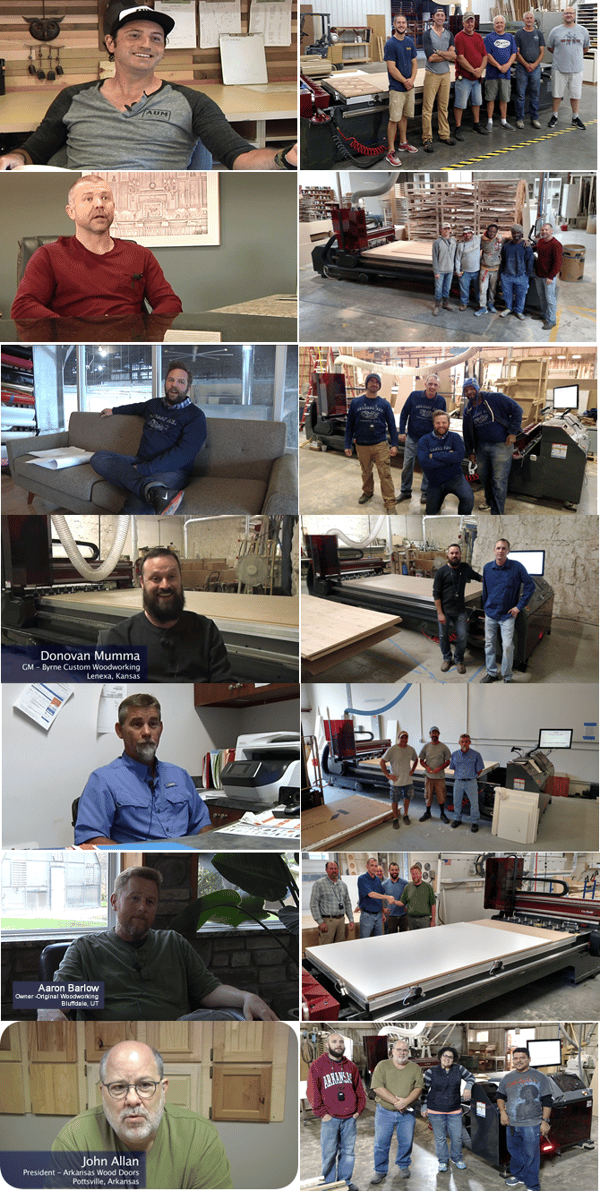
What Some of Our Cut Center Owners Are Saying...

See What Our Cut Center Owners Are Saying About how Their Machines Have Improved Their Business.

Click for More Info on the Thermwood Cut Center


Air Force Research Laboratory, Boeing and Thermwood Partner on Low Cost Responsive Tooling Program

Posted by Duane Marrett on Thu, Aug 08, 2019

Tags: Thermwood, Announcements, Additive, LSAM, Thermwood LSAM, Additive Manufacturing, Boeing, Air Force, Air Force Research Laboratory

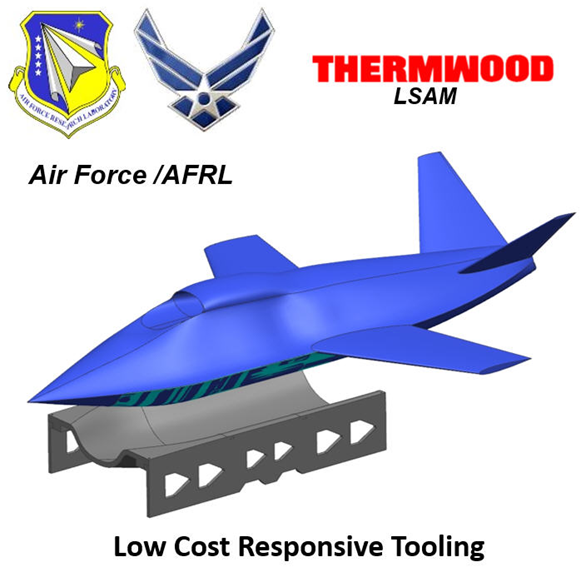
The United States Air Force Research Laboratory (AFRL) Manufacturing and Industrial Technology Division (ManTech) is interested in large scale polymer-based additively manufactured (AM) composite cure tooling. Boeing submitted an idea to ManTech’s Open BAA to evaluate the current state of additive manufacturing technology with respect to the fabrication of low cost autoclave capable tools for the production of composite aerospace components. The initial demo tool is for an AFRL concept aircraft fuselage skin (Figure 1). Boeing contracted Thermwood to demonstrate capability of their Large Scale Additive Manufacturing (LSAM) machine.  

Air Force Research Laboratory Conceptual Aircraft & Full-Scale Tool

Figure 1: Air Force Research Laboratory Conceptual Aircraft & Full-Scale Tool


Please click below for video


The Thermwood LSAM machine offers an innovative additive manufacturing machine capability with its Vertical Layer Printing (VLP). The vertical layer printing AM process provides a significant cost benefit by increasing the size components can be printed, thus reducing assembly cost for large tools. To validate the VLP process using high temperature autoclave-capable materials, Boeing and AFRL chose to 3D print a section of the large tool to evaluate the LSAM functionality. The Mid-Scale tool was printed on Thermwood’s LSAM  Additive Manufacturing Demonstration machine in Southern Indiana using a 40mm print core running 25% carbon fiber reinforced Polyethersulfone (PESU).

Mid-Scale Tool 3D Printing on Large Scale Additive Manufacturing (LSAM)
Figure 2: Mid-Scale Tool 3D Printing on Large Scale Additive Manufacturing (LSAM)

The initial test tool has the same width, height and bead path as the final mold, incorporates all major features of the final mold, but compressed in length being only 4 feet long. The final tool will be over 10 feet long. The Mid-Scale tool set a milestone achievement as the first high temperature tool printed using the VLP system. The Mid-Scale tool required 5 hours, 15 minutes to print with a print weight of 367 lbs. After final machining, the tool was probed for surface profile and tested for vacuum integrity. The tool passed room temperature vacuum test and achieved dimensional surface profile tolerances. The Full-Scale tool will weigh approximately 1400 pounds and require 18 hours to print.

Machining (left) and Probe (right) operation on a Thermwood LSAMFigure 3: Machining (left) and Probe (right) operation on a Thermwood LSAM
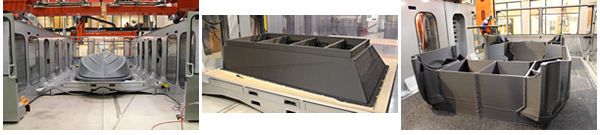

The program is progressing to the next step, producing a full size tool. Boeing and the Air Force are carefully documenting all operational parameters of the project to transition the technology to production programs. Additive manufactured autoclave tooling offers significant advantages over traditional methods of producing these tools. 3D printed tooling is less expensive and can be fabricated in days or weeks rather than months.

AFRL is very interested in tooling approaches for the Low-Cost Attributable Technology (LCAAT) program which has a goal to break the cost growth curve and field new systems faster.  AFRL Program Manager Andrea Helbach says, “We are interested in additively manufactured tooling’s ability to reduce the cost and time to procure autoclave capable tooling.  Additionally, AM tooling supports changes in vehicle design with minimal non-recurring expenses.” 

“Future fielded low cost, but capable UAV’s will need a responsive materials and manufacturing processes strategy” says Craig Neslen, LCAAT Initiative Manufacturing Lead.  “Additive manufactured composite tooling is one of many technologies being evaluated to ensure the industrial base can handle future manufacturing surge requirements as well as accommodate periodic system tech refresh activities which could necessitate minor vehicle design changes at an acceptable cost.”  


More Information on LSAM

LSAM is based on exciting new technology developed from an entirely new direction.

LSAM is intended for industrial production. It is not a lab, evaluation or demonstration machine, but is instead a full-fledged industrial additive manufacturing system intended for the production of large scale components.

Thermwood has already applied for 19 separate patents on various aspects of this new technology (several have already been granted and more will be coming as development continues). LSAM is truly “state of the art” in this exciting new world of Large Scale Additive Manufacturing. 

The Secret to LSAM Print Quality...A Different Process

Examples of large parts easily printed on Thermwood's LSAM

Click for More Info on the Thermwood LSAM

Ascent Aerospace Invests in Additive Manufacturing

Posted by Duane Marrett on Wed, Jul 17, 2019

Tags: Thermwood, Announcements, Why Purchase a Thermwood, Additive, LSAM, Thermwood LSAM, Additive Manufacturing, Ascent Aerospace

Ascent Aerospace Invests in Thermwood LSAM Additive Manufacturing

Santa Ana, CA - July 2019 – Ascent Aerospace, a leading provider of aerospace tooling systems, factory automation and integration solutions, is excited to announce its recent investment of a Large Scale Additive Manufacturing (LSAM) machine from Thermwood Corporation, a technology leader and manufacturer of CNC and 3D printing equipment based in Dale, IN.

With a 10’ x 40’ fabrication area, Ascent’s LSAM machine will be the largest available in the aerospace market, allowing for both the printing and machining of a wide range of thermoplastic composite materials.

With a 10’ x 40’ fabrication area, Ascent’s LSAM machine will be the largest available in the aerospace market, allowing for both the printing and machining of a wide range of thermoplastic composite materials.

The use of 3D printing in the aerospace tooling sector has continued to mature over the last several years and is accelerating in usage; with this, Ascent Aerospace plans to answer the industry's call and take additive technology to a new level by leveraging its deep expertise in tooling to commercialize production ready additive solutions. As a new tooling option for its customers, Ascent intends to utilize the LSAM machine to bring tools such as layup molds, masters, trimming/drilling fixtures and vacuum holding fixtures to market faster than ever before. The LSAM machine will be co-located with Ascent's composite tooling shop, autoclave and clean room in Santa Ana, California, and will allow Ascent to build targeted tools lighter and more efficiently, providing time and cost savings to its global customers.

The LSAM machine will have an industry leading build area, providing aerospace customers the opportunity to benefit from large-scale printed composite tooling. By combining this technology with Ascent's in-house tooling expertise and heritage engineering, it will be possible to fabricate and deliver fully functional select fixtures and molds with significantly reduced lead-times of a traditional metallic tool. The wide variety of materials that are compatible with the LSAM, such as ABS, Polycarbonate, Nylon, and PESU resins with reinforcing compounds, will further expand the selection of tooling solutions that Ascent will bring to the market. 

Michael Mahfet, the CEO of Ascent Aerospace, stated, "Our investment in the LSAM represents the next milestone in Ascent's multi-year technology roadmap and realization of expansive efforts studying the benefits of additive manufacturing within the aerospace tooling market. This capability positions us to remain the leader in new and innovative tooling solutions, supporting strong collaboration with our customers and supplementing our in-house, vertically integrated design and fabrication capabilities."

Ascent Aerospace is committed to challenging the industry norms, improving manufacturing processes and providing customers with the best solutions to meet their demands.

About Ascent Aerospace

Ascent Aerospace is a world renowned, single-source provider of production and automated assembly systems for the aerospace and defense industry. As the largest tooling group in the industry, Ascent produces a full suite of both mold and assembly tooling required for the aerospace manufacturing market, including the largest Invar molds ever made for aerospace.  As an automation provider and production system integrator, Ascent works with customers to develop their project and see it through from process engineering, to build and installation to ensure it is an efficient and cost effective solution. Visit www.ascentaerospace.com for more information.

More Information on LSAM

LSAM is based on exciting new technology developed from an entirely new direction.

LSAM is intended for industrial production. It is not a lab, evaluation or demonstration machine, but is instead a full-fledged industrial additive manufacturing system intended for the production of large scale components.

Much of the technology used in Thermwood’s LSAM machines and print process is completely new. Thermwood has already received numerous patents on these revolutionary developments and many more are in the works. In addition to the projects already announced, many other exciting results that LSAM has already achieved are covered by non-disclosure agreements and must be kept secret. LSAM is truly state-of-the-art in the exciting new world of large scale additive manufacturing.

The Secret to LSAM Print Quality...A Different Process

Examples of large parts easily printed on Thermwood's LSAM

Click for More Info on the Thermwood LSAM

Thermwood 2019 Scholarship Recipients

Posted by Duane Marrett on Wed, May 22, 2019

Tags: Thermwood, Announcements, Scholarship, 2019

Thermwood is proud to announce Audrey Jones and Mackenzie Tullis as our scholarship recipients for the Class of 2019.  Each will receive a $2,000 renewable scholarship.  Since the introduction of these renewable scholarships, Thermwood has awarded over $200,000 to students wishing to further their education. 

Audrey Jones

Audrey Jones is the daughter of Amie and Carl Jones of Ferdinand, IN.  She is a graduate of Forest Park High School. She has been involved in Community Impact, Student Council 9th and 10th grade, Key Club, 4H, and Golf. 

While at Forest Park she has received most improved Sophomore in Band, State Runner Up in Band, and MVP in Golf for 2 years. 

This fall Audrey will be attending IUPUI to study Clinical Lab Science.

.


Mackenzie TullisMackenzie Tullis is the daughter of Mark and Melanie Tullis of Lincoln City, IN. She is a graduate of Heritage Hills High School.  She has been a member of Patriot Vibe. 

Mackenzie will be studying Dental Hygiene at the University of Southern Indiana.


Thermwood would like to congratulate all seniors of the Class of 2019 and wish them the very best in their future studies and endeavors!